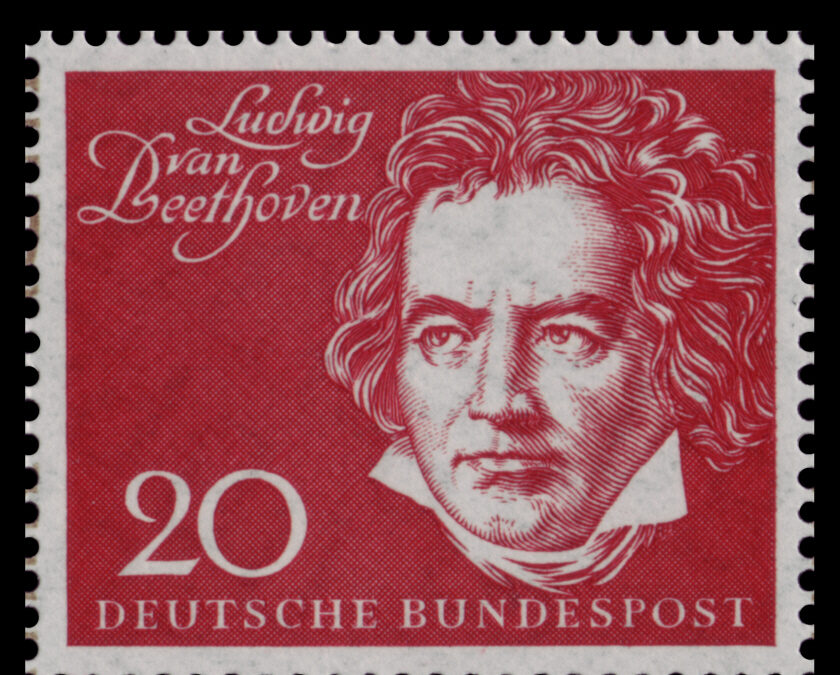
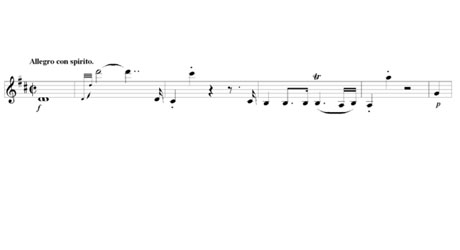
Driving rhythms characterize this joyous symphony, described by none other than Wagner as “the apotheosis of the dance.” Premiered in Vienna 1813, Beethoven’s 7th Symphony received enthusiastic reviews, with the audience even demanding an encore of the second movement! Outside Vienna, reaction was not as favorable (the noted composer Carl Maria von Weber said that “Beethoven was ripe for the madhouse;” Friedrich Wieck, Clara Schumann’s father, called it “the work of a drunkard”). Little did they know; over time these critics were proved wrong, and this magnificent, powerful symphony has become one of Beethoven’s most enduring and well-loved works.
Each of its four movements is built around a specific rhythmic motif. After a contemplative introduction (almost a movement in itself), the opening Allegro’s three-note theme is introduced by the woodwinds, taken up by the strings in turn, and traded back and forth among strings, woodwinds and brass.
The famous second movement Allegretto is a somber march built around a five-note motif (long-short-short-long-long) starting in the lower strings, with a subtle singing countermelody taken up in turn by the rest of the orchestra. A lyrical interlude featuring clarinet and bassoon offers a warm ray of sunshine in the middle of the movement.
The third movement Presto is based on a relentless three-note motif, interspersed with a sonorous trio section featuring winds and brass. This combination is repeated several times (with surprise variations).
The energetic last movement has been described as “elemental fury unleashed.” It features driving 16th-note runs, offbeat accents, brass/wind fanfares and exclamation points, and a long coda culminating in a marking of “triple forte” (fff) — the first use of that marking in a Beethoven score. Accelerating driving passages bring this symphony to its triumphant conclusion.
This delightful overture is the precursor to Mozart’s last opera, and indeed one of his last compositions. It opens with three grand chords and a slow adagio evoking the high priest Sarastro and his attendants. A lively allegro, built on four repeated notes, is taken up in turn by strings, winds and brass.
The overture’s contrasting elements, by turns grandiose and playful, make a perfect introduction to the opera which also embodies them.
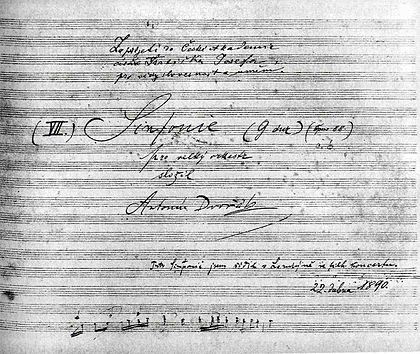
This symphony was composed by Dvorak in a short span of several months in 1889. A sunny, cheerful work, it alternates major and minor keys in each of its four movements.
Dvorak wrote this work in a new style, transitioning from traditional symphonic structure (exposition-development-recapitulation) towards a more poetic musical structure, stitching together many melodic and thematic fragments (particularly evident in the first movement).
The symphony opens with a wistful theme in G minor by ‘celli, clarinets, bassoon and horn. The violins lead an energetic transition to G Major; a clarinet theme in minor keys is interspersed several times in the movement, which ends on an optimistic note.
The second movement is more introspective. Beginning softly in the strings, upper winds join in to combine in a duet. Singing passages in C Major, first in the winds and then in the strings, lead to rousing climaxes featuring brass and timpani.
The third movement is a graceful waltz, bracketed by a folk-melody trio and a sudden vivace at the end. A rousing trumpet flourish starts off the last movement. A series of string variations feature ‘celli and violas, abruptly followed by a rousing orchestral Allegro. Midway through the movement, Dvorak gives the winds a contrasting restless theme in C minor. The “theme and variations” return in the strings and woodwinds; the main Allegro theme then reappears. Led by surging horns, trumpets and trombones, the symphony accelerates to a triumphant close.
Jean Sibelius (1865-1957), Finland’s foremost composer, had a major impact on its national identity and musical life. His symphonies are cornerstones of the orchestral repertoire, as are his tone poems based on Finnish myths and national themes.
The Karelia Suite had its origins in 1893, when Sibelius was asked by Helsinki University students to compose incidental music for a gala with historical pageants; these were based on historical events in Karelia province (the southwestern region of Finland next to Russia). His music for three of those pageants became the basis for the Karelia Suite.
The first movement, with its spirited march theme, depicts the gathering of taxes by a Lithuanian duke in the 14th century (!).
The second movement Ballade portrays a bard entertaining group of nobles in a medieval castle.
The jaunty Alla Marcia depicts the Swedish conquest of a Finnish town in the 16th century.
Tchaikovsky composed this short work in 1887 while tending a seriously ill friend in Germany. This experience affected him emotionally, and is reflected in the melancholy nature of this piece.
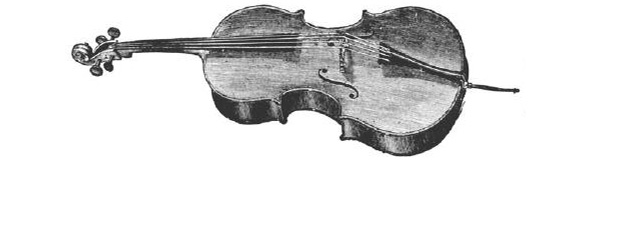
The opening is somber and impassioned; it’s then followed by a lyrical singing main theme. There is a sudden change into a virtuosic scherzo, with brilliant ‘cello passage work. After a return to the lyrical theme, the scherzo makes a final appearance.
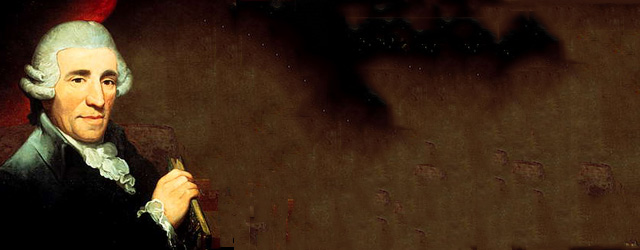
This remarkable work was composed by Haydn while he was on his second visit to London in 1792.
It was initially prompted by a rivalry: Haydn’s former pupil Ignaz Pleyel had composed and performed a “sinfonia concertante” in London in early 1792, featuring a number of solo instruments set off against the orchestra. This musical form was very much in vogue in both Paris and London at the time. In response, the impresario and violinist Johann Peter Salomon, the sponsor of Haydn’s London concerts, asked Haydn to compose a similar work for an upcoming concert in two months.
Haydn set to work and composed this sparkling piece work in short order. It features a solo quartet (violin, ‘cello, oboe and bassoon), as well as a full symphony orchestra, in a combination of concerto and concerto grosso styles.
There are some unusual features: in the first movement the solo quartet enters in the midst of the orchestral theme, engaging the orchestral forces even before their own solo entrance.
The middle movement features chamber music among the soloists, and is almost conversational in style.
The last movement starts off as a conventional allegro, but is suddenly interrupted by a number of operatic recitatives played by the solo violin – in the London premiere by Salomon himself.
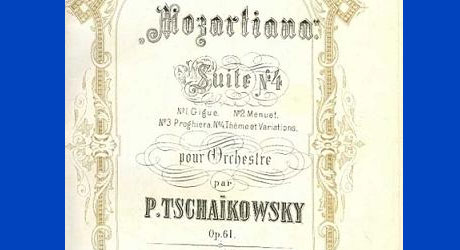
Tchaikovsky doesn’t sound much like Mozart. The Russian composer wallowed in Romantic angst, unlike his self-confident musical predecessor from the Classical period a century earlier. Nonetheless, Peter idolized Wolfgang. The Mozartiana is Tchaikovsky’s homage to the Master on the occasion of the 100th anniversary of Mozart’s opera Don Giovanni. Exposure to that opera as a child sparked Tchaikovsky’s entire musical career.
By serendipity, Tchaikovsky had a chance to view the original score of his favorite opera, owned by an acquaintance in Paris, the year before he composed Mozartiana. He used religious terminology when he wrote about handling the manuscript in a letter to his patroness, Nadezhda von Meck: “I cannot describe the feeling which came over me when I looked through this musical holy of holies.”
Tchaikovsky didn’t just admire Mozart’s music, but revered Mozart, the person, as a genius and an ideal human being. In another letter to his patroness, who did not share his enthusiasm for Mozart, he described his hero as having “a wonderful, irreproachable, infinitely kind, and angelically pure nature… He was the incarnation of the ideal of a great artist who creates because of an unconscious stirring of his genius. He wrote music as the nightingales sing, i.e. without pausing to think, without doing violence to himself…Everyone loved him; he had the most marvelous, cheerful, and equable temperament. There was not a whit of pride in him… The purity of his soul was absolute. He knew neither envy nor vengefulness nor spite, and I think that all this can be heard in his music, which has reconciling, clarifying, and caressing properties.” In other words, Mozart’s putative flawless character was everything that the self-tortured Tchaikovsky’s was not, but that he yearned for.
For his Mozartiana Tchaikovsky didn’t dare borrow themes from the opera that occasioned the tribute or any of Mozart’s most important works. Instead, he decided to borrow lesser themes, hoping to avoid the charge of hubris for rewriting masterpieces in a contemporary idiom. Instead, he hoped people would see him as drawing attention to overlooked gems. Or something like that. Tchaikovsky is known for brooding emotion rather than cold logic.
The piece was written during a stay with his younger brother Anatoly in Tiflis, now known as Tbilisi, in Georgia. Originally, Tchaikovsky had intended to translate the libretto of Don Giovanni and collaborate on an essay on the composer he so venerated as well, but only the Mozartiana was completed.
Tchaikovsky viewed it as merely an orchestration or arrangement of the original Mozart pieces. “In the course of the orchestration I made minute enhancements and modifications to the harmony,” the composer wrote to his publisher. The original Mozart pieces were for piano, excerpt for the basis of the third movement, which was originally a motet (sacred choral piece for several voices). But the great Hungarian pianist and composer Franz Liszt had transcribed the motet for piano, and Tchaikovsky worked from the secondary source. And for the fourth movement, a Theme and Variations for piano, Mozart had borrowed a theme from a very silly comic opera by Gluck, The Pilgrimage to Mecca.
You might forgive a listener unable to recognize the Mozart in Tchaikovsky’s rendition. It sounds more like The Nutcracker than like Eine Kleine Nachtmusik. While most of the scoring is consistent with an orchestra from Mozart’s day, Mozartiana sounds richer and lusher than anything Mozart might have been familiar with. Tchaikovsky expands the percussion section (listen for the Glockenspiel in the final movement) and adds a heavenly harp to the third movement, Pregheira (Prayer). Yet some of the classical purity shines through, especially in the first two movements.
The first movement is a jig [Gigue], marked Allegro (fast and happy), from Mozart’s Eine kleine Gigue for piano (KV 574).
The second movement is a court dance, Minuet [Menuet], marked Moderato, from Mozart’s Menuett for piano (KV 355).
The third movement, Prayer [Pregheira], is marked Andante non tanto (slower but not too much—walking tempo), after Mozart’s motet Ave Verum Corpus (KV 618) in a transcription for piano solo by Franz Liszt.
The final movement showcases solo talent from throughout the orchestra, especially the principal violin. It is a Theme and Variations [Thème et variations] with the tempo marking Allegro giusto (truly fast and happy, with energy) from Mozart’s Ten Piano Variations on a Theme by Gluck, K. 455.
All four movements together add up to about 25 minutes of playing time, with more than half of that of that devoted to the last movement. Ballet lovers may find Mozartiana familiar, as George Balanchine choreographed it in 1981, although he reshuffled the order of the movements.
Mozart wrote this work in 1782 for the ceremonies surrounding the ennoblement of Sigmund Haffner, a member of a prominent Salzburg family. He originally wrote this piece as a six-movement serenade, including an introductory march and two minuets. He wrote it in just a few short weeks in the summer, and there is no record of a performance at that time. However, in December 1782 Mozart decided he wanted to perform it in Vienna in a concert and asked his father for the score.
When he received the score, Mozart was astonished at how good it was, because he had forgotten every note of it! He promptly went about revising the piece for his upcoming performance. He dropped the introductory march and one minuet and organized it into the familiar four-movement symphony we know today. A few years later he added flutes and clarinets to the outer movements.
The symphony’s outer movements are full of brilliant passagework, flair, and dash. Mozart specified that the first movement was to be played “with great fire.” It opens with a famous octave leap upwards, and then downwards, with embellishments — a theme which is repeated throughout. The second movement is a simple (yet subtle) andante, with a relaxed atmosphere. It first features a lyrical violin melody accompanied by a wind chorale; the contrasting second theme is introduced by the 2nd violins and violas. The third movement is a foursquare minuet, with a lyrical counterpoint in the trio. The final presto (according to Mozart, “as fast as possible”) opens with witty understatement, spins out an intimate second theme, and ends with a magnificent triumphal flourish.
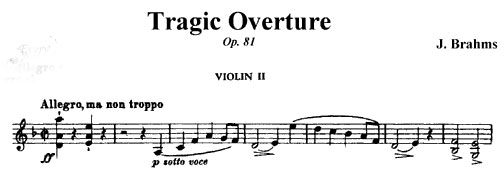
Johannes Brahms composed The Tragic Overture, Op 81 in the fall of 1880 as a companion to the Academic Festival Overture, Op. 80 written a few months earlier. In a letter to Karl Reinecke, Brahms wrote: “one [overture] weeps while the other laughs”.
According to the writer and music critic Max Kalbeck, the Tragic Overture was inspired by Goethe’s Faust for which Brahms is said to have intended to write incidental music (a claim denied by the composer). The dramatic and contrasting character of the two main themes of the overture is more than evident and the themes’ very individual and character-like qualities support Kalbeck’s claim.
The formal organization of the overture also seems to support Kalbeck’s theory. The two main themes are both “square” with their 8-measure structure and both have their preliminary development in the exposition. The development section is designed as a separate section with its own austere (Molto Piu Moderato) character. It borrows material from the first theme of the exposition, but is reshaped in a completely different manner. Another interesting moment in the overture is the beginning of the recapitulation where the first theme is omitted in favor of a differently orchestrated second theme.
The overture ends in a manner similar to the ending of Beethoven’s Fourth Symphony – a deceptive retreat, followed by sudden intensity.