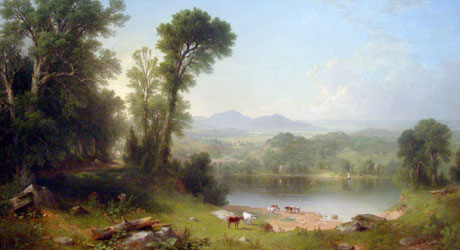
This is one of the best-known and most programmatic symphonies in classical music.
Composed in 1808, it reflects Beethoven’s deep feeling for nature, no doubt due in some measure to his numerous walks in the countryside around Vienna. Each of the five movements is subtitled and reflects a particular mood.
The first movement allegro (“awakening of joyful feelings on arriving in the country”) is announced by the violins, and in turn taken up by winds and the full orchestra. “Scene at the brook” features a rustling accompaniment of second violins, violas and solo ‘cellos set against melodic motifs in the first violins and winds. Rustic dances are featured in the “happy gathering of the country folk” which follows.
The dramatic “thunder, storm” movement, with sudden bursts by timpani and brass, suddenly interrupts the country revels. Then the storm departs, the sun breaks through, and the “shepherd’s song,” with “happy and thankful feelings after the storm,” takes us to the end of this musical journey.
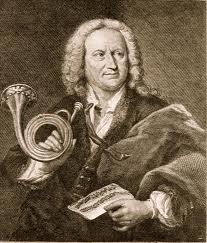
As part of his vast output of vocal and orchestral works, Bach wrote four orchestral suites (or “ouvertures”), probably between 1724 and 1739. They are based on the 18th-century “French style” of overture – a slow opening section with a faster middle section, followed by a variety of dance movements.
Bach’s Fourth Suite is brilliantly scored for trumpets, oboes, timpani and strings, and features all of these forces in its scope.
From the Performance of Fall, 2017.
Ouverture
by J.S. Bach | The Broadway Bach Ensemble Autumn, 2017
Bouree I and II
by J.S. Bach | The Broadway Bach Ensemble Autumn, 2017
Gavotte
by J.S. Bach | The Broadway Bach Ensemble Autumn, 2017
Menut I and II
by J.S. Bach | The Broadway Bach Ensemble Autumn, 2017
Rejouissance
by J.S. Bach | The Broadway Bach Ensemble Autumn, 2017
It begins with a magnificent overture, followed by a lively fugue in 9/8 time showcasing Bach’s mastery of counterpoint, concluding with the stately opening procession.
The following four dance movements are diverse, each showcasing different sections of the orchestra. Trumpets, oboes and bassoon feature in the lively Bourrée and robust Gavotte; woodwinds and strings combine in an elegant Menuet, with a middle section scored for solo strings.
The Suite ends with a rousing Réjouissance (literally, rejoicing or celebration) featuring the entire ensemble.