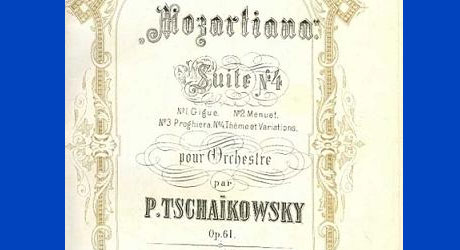
Tchaikovsky doesn’t sound much like Mozart. The Russian composer wallowed in Romantic angst, unlike his self-confident musical predecessor from the Classical period a century earlier. Nonetheless, Peter idolized Wolfgang. The Mozartiana is Tchaikovsky’s homage to the Master on the occasion of the 100th anniversary of Mozart’s opera Don Giovanni. Exposure to that opera as a child sparked Tchaikovsky’s entire musical career.
By serendipity, Tchaikovsky had a chance to view the original score of his favorite opera, owned by an acquaintance in Paris, the year before he composed Mozartiana. He used religious terminology when he wrote about handling the manuscript in a letter to his patroness, Nadezhda von Meck: “I cannot describe the feeling which came over me when I looked through this musical holy of holies.”
Tchaikovsky didn’t just admire Mozart’s music, but revered Mozart, the person, as a genius and an ideal human being. In another letter to his patroness, who did not share his enthusiasm for Mozart, he described his hero as having “a wonderful, irreproachable, infinitely kind, and angelically pure nature… He was the incarnation of the ideal of a great artist who creates because of an unconscious stirring of his genius. He wrote music as the nightingales sing, i.e. without pausing to think, without doing violence to himself…Everyone loved him; he had the most marvelous, cheerful, and equable temperament. There was not a whit of pride in him… The purity of his soul was absolute. He knew neither envy nor vengefulness nor spite, and I think that all this can be heard in his music, which has reconciling, clarifying, and caressing properties.” In other words, Mozart’s putative flawless character was everything that the self-tortured Tchaikovsky’s was not, but that he yearned for.
For his Mozartiana Tchaikovsky didn’t dare borrow themes from the opera that occasioned the tribute or any of Mozart’s most important works. Instead, he decided to borrow lesser themes, hoping to avoid the charge of hubris for rewriting masterpieces in a contemporary idiom. Instead, he hoped people would see him as drawing attention to overlooked gems. Or something like that. Tchaikovsky is known for brooding emotion rather than cold logic.
The piece was written during a stay with his younger brother Anatoly in Tiflis, now known as Tbilisi, in Georgia. Originally, Tchaikovsky had intended to translate the libretto of Don Giovanni and collaborate on an essay on the composer he so venerated as well, but only the Mozartiana was completed.
Tchaikovsky viewed it as merely an orchestration or arrangement of the original Mozart pieces. “In the course of the orchestration I made minute enhancements and modifications to the harmony,” the composer wrote to his publisher. The original Mozart pieces were for piano, excerpt for the basis of the third movement, which was originally a motet (sacred choral piece for several voices). But the great Hungarian pianist and composer Franz Liszt had transcribed the motet for piano, and Tchaikovsky worked from the secondary source. And for the fourth movement, a Theme and Variations for piano, Mozart had borrowed a theme from a very silly comic opera by Gluck, The Pilgrimage to Mecca.
You might forgive a listener unable to recognize the Mozart in Tchaikovsky’s rendition. It sounds more like The Nutcracker than like Eine Kleine Nachtmusik. While most of the scoring is consistent with an orchestra from Mozart’s day, Mozartiana sounds richer and lusher than anything Mozart might have been familiar with. Tchaikovsky expands the percussion section (listen for the Glockenspiel in the final movement) and adds a heavenly harp to the third movement, Pregheira (Prayer). Yet some of the classical purity shines through, especially in the first two movements.
The first movement is a jig [Gigue], marked Allegro (fast and happy), from Mozart’s Eine kleine Gigue for piano (KV 574).
The second movement is a court dance, Minuet [Menuet], marked Moderato, from Mozart’s Menuett for piano (KV 355).
The third movement, Prayer [Pregheira], is marked Andante non tanto (slower but not too much—walking tempo), after Mozart’s motet Ave Verum Corpus (KV 618) in a transcription for piano solo by Franz Liszt.
The final movement showcases solo talent from throughout the orchestra, especially the principal violin. It is a Theme and Variations [Thème et variations] with the tempo marking Allegro giusto (truly fast and happy, with energy) from Mozart’s Ten Piano Variations on a Theme by Gluck, K. 455.
All four movements together add up to about 25 minutes of playing time, with more than half of that of that devoted to the last movement. Ballet lovers may find Mozartiana familiar, as George Balanchine choreographed it in 1981, although he reshuffled the order of the movements.
Belgian playwright Maurice Maeterlinck’s Pelléas et Mélisande tells the story of Golaud who encounters the mysterious Mélisande in the forest, and marries her. But very soon, Mélisande finds her true love in the person of Pelléas, Golaud’s half-brother. Golaud becomes suspicious of the lovers, killing Pelléas and wounding Mélisande. Mélisande dies in childbirth, and Golaud continues his descent into madness.
In the twelve years following the play’s 1893 premiere in Paris, four great composers wrote music inspired by Maeterlinck’s masterpiece – Claude Debussy (opera), Gabriel Faure (incidental music), Arnold Schoenberg (symphonic poem) and Jean Sibelius (incidental music).
After Debussy completed an early version of his opera in 1895, British actress Mrs. Patrick Campbell (soon to play the role of Mélisande in London), requested Debussy to excerpt a symphonic suite from the opera to accompany the play’s London production. Debussy refused. Mrs. Campbell then asked Faure to write incidental music to Maeterlinck’s play. Faure agreed. After a one-month collaboration with orchestrator Charles Koechlin, the score of the Incidental Music to Pelléas et Mélisande, Op. 80 was ready. Maeterlinck, present at the 1898 London premiere of the translated play — accompanied by Faure’s incidental music — wrote to Mrs. Campbell, “In a few words, you filled me with an emotion of beauty the most complete, the most harmonious, the sweetest that I have ever felt to this day.”
The orchestral suite consists of four numbers — Prelude (the prelude to Act I in Faure’s complete orchestral score), La Fileuse (Mélisande at the spinning wheel), Sicilienne (the actual prelude to Act II with one of the most famous flute solos in the symphonic repertoire) and La Mort de Mélisande (the Prelude to Act III).
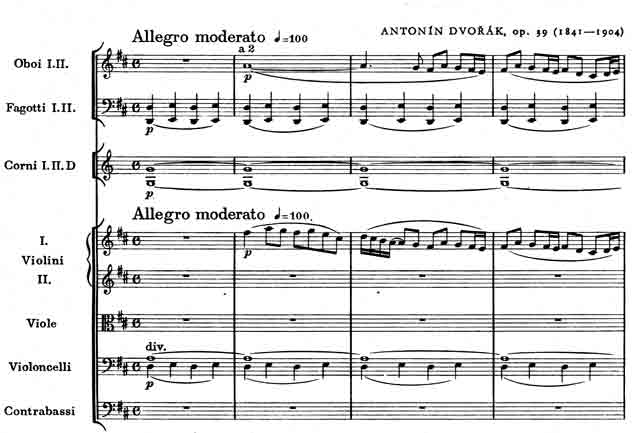
The Czech Suite was one of several works Dvořák composed for small orchestra between 1875 and 1879 (the others being his masterful string and wind serenades). While scored for a Mozart-sized orchestra (much smaller than his symphonies), it has the beauty, sweep and grandeur of Dvořák’s larger works.
The Suite is in five movements, several of which are based on Czech dance forms. A tranquil Pastorale opens this work, essentially a prelude based on a simple descending theme passed around various string and wind sections. Next come two specifically Czech dance movements — a Polka, featuring a rising graceful theme in the violins, with a lively trio; and then a country minuet (“Sousedská”), opening with a decisive statement from clarinets and bassoons.
A short lyrical romance follows, featuring upper winds (flutes, oboes, English horn) and charming wind and string dialogues.
The finale is based on a boisterous Czech dance form, the “Furiant” (also used by Dvořák in other instrumental works), full of drive, syncopation and rhythmic flourishes, and ending in a fiery dash.
Jean-Joseph Mouret (1682-1738) was a court composer active in France during the reigns of Louis XIV (the “Sun King”) and his son, Louis XV. Very few of his compositions have survived, and even fewer are known to the public.
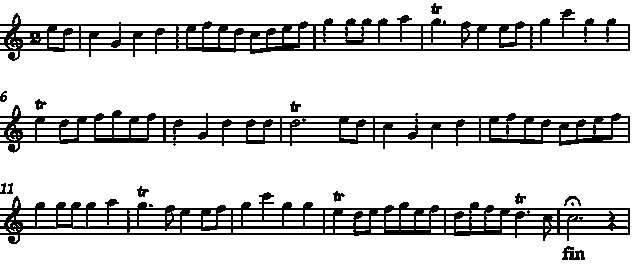
The major exception is this collection of fanfares known as his “Premiere Suite de Symphonies” which was first performed for Louis XV. The Suite has four movements, each with a different character, and each featuring contrasting forces – strings and woodwinds; trumpets; and timpani.
The Suite opens with a Rondeau, a grand fanfare (also known as the “Masterpiece Theater” theme), with 2 contrasting couplets. The second movement is a graceful minuet, played first by strings and woodwinds, with trumpets and timpani joining in; there are two string couplets in the middle of the movement, followed by a return to the opening minuet. Next is a sprightly march, in 18th-century military style. A short lilting final movement (“Guay”) closes out this work.
Mouret’s formalized style emphasizes rhythmic precision and simplicity of line, and typifies the French style in baroque music.
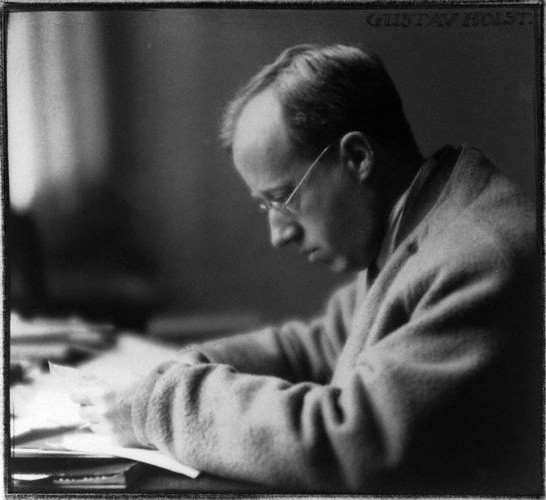
Gustav Holst (1874-1934) was active as a composer and teacher in the first part of the 20th century. He played a number of instruments, including piano, violin and trombone, and is best known for his large-scale orchestral work, “The Planets.”
Holst composed many other works which were emblematic of early 20th-century British music – including a number of pieces for band which have become staples in the concert band repertoire.
He wrote the First Suite in E-Flat Major in 1909. It is a three-movement work based on the musical theme which opens the first movement, the “Chaconne” – itself a throwback to a slow triple-meter dance from the 17th-18th century. The opening 8-bar low brass melody is repeated 15 times, with variations in instrumental combinations, mood, and tonality. The following Intermezzo is a lively variation on the opening melody, but completely different in feel – reminiscent of an English folk song.
The closing March, whose second theme is also based on the “chaconne” theme, has a distinct “military” air about it. Instrumental ruffles and flourishes, and multiple interwoven melodies, lead in the end to a grand climax.
Benjamin Franklin, one of our country’s founding fathers, was well-known as a statesman, diplomat, writer, printer, scientist and inventor – but a composer, too? Franklin’s interest in music is well-known. He printed treatises on music, played several instruments (including violin, harp, viola da gamba and guitar), and designed a four-sided music stand for string quartet players. He even invented the glass harmonica – an instrument made of rotating tuned glass bowls played by holding wet fingers against the edges, for which Mozart and Beethoven wrote compositions!
In 1946, a manuscript of a 5-movement string quartet was uncovered in the Bibliothèque Nationale in Paris, bearing the title “Quartetto a 3 Violini Con Violoncello Del Sigre Benjamin Francklin.” It was originally (and unusually) scored for 3 violins and ‘cello to be played in “scordatura” fashion – all on open strings, with specific string tunings indicated for each instrument!
The quartet was published and attracted immediate attention from musicians and scholars, including Alan Shulman, an American composer and ‘cellist (1915-2002). Mr. Shulman, a pre-eminent ‘cellist and member of the NBC Symphony Orchestra under Arturo Toscanini, used excerpts from the Franklin quartet in his score for the NBC radio series “American Portraits” in 1950. In 1963, he created the present Suite based on thematic material from the quartet, maintaining its original key and structure. One of its notable performances was by the Philadelphia Orchestra during the 1976 Bicentennial.
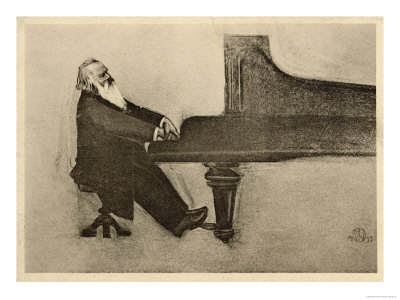
The root of Brahms’ music lies in the tension between the duple and the triple rhythmic pulse. The inspiration for this can be traced back to his great fondness for the so-called “gypsy” music of Hungary.
In 1852, as a nineteen-year-old pianist, the young Brahms accompanied the Hungarian violinist Eduard Remenyi, whose musical style was greatly influenced by the verve and freedom of the gypsy violin. Brahms developed a great affection for this style and in 1869 wrote his Hungarian Dances for piano duet based upon Magyar folk melodies. He later orchestrated many of these Dances and they are part of our standard repertoire today.
Fauré was commissioned to write the music for this suite by Prince Albert I of Monaco in 1919 as accompaniment to a choreographic divertissement. This “staged entertainment” was inspired by a Paul Verlaine poem and premiered in Monte Carlo.
In 1920, Fauré arranged the music as a four-movement suite. It consists of a Mozartian overture; a menuet and gavotte in faintly baroque style, and a final pastorale.
Of interest from a composition point of view is that the first three movements were, essentially, orchestrations of earlier works that Fauré had composed for piano some 50 years earlier. The dreamlike, wistful pastorale was composed in 1919, just 5 years before his death.
By profession an eminent chemist and professor, Borodin (1833-1887) was also a member of a Russian musical circle which included Mussorgsky and Rimsky-Korsakov.
While his musical output was not large, it includes some of the best-known Russian classical works, including a number of symphonies, his D Major string quartet (with the famous Nocturne), and his masterpiece, the opera Prince Igor.
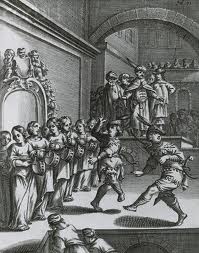
The Polovtsian Dances come from the second act of the opera, in which the Khan of the Polovtsi, a Mongol tribe, is entertaining Prince Igor, whom he has taken captive.
While a chorus is used when the dances are played in the opera, they are often played by instruments alone in a concert setting, as we are doing today. An initial processional characterized by wind solos against a plucked string and harp accompaniment gives way to a series of dances alternatively featuring dancing girls, warriors (fast descending clarinet motif); and young boys (leaping wind and string motifs). An accelerating coda brings the piece to its conclusion.
The Bach family of central Germany was prolific, producing generations of musicians from the 16th through the 19th centuries. While its greatest exemplar was undoubtedly Johann Sebastian Bach, many other Bach family members achieved local and international renown as instrumentalists and composers.
One of these was Johann Bernhard Bach, who was Johann Sebastian’s cousin and contemporary. He studied organ with his father (Johann Aegidius Bach) and then took up successive posts as organist and harpsichordist in Erfurt, Magdeburg and Eisenach, where he worked from 1703 until his death in 1749.
Besides his instrumental talents, Johann Bernhard was also a gifted composer. While little of his work has survived, the works that have come down to us include four orchestral suites. The suites show Georg Philipp Telemann’s influence (as was remarked by contemporaries); Johann Bernhard probably became acquainted with Telemann in Eisenach (where Telemann also worked from 1706-1712). Of interest, Johann Sebastian so esteemed his cousin’s suites that he was involved in copying them for his own use (which is how they were preserved).
The G major suite we are playing today is scored for strings and continuo, to which we have added oboes and bassoons as was often done at the time. The work opens with an “overture” in French style, with stately and sprightly sections. After that there are six contrasting movements based on stylized French dances, which alternately convey elegance, gaiety, introspection and joy.