
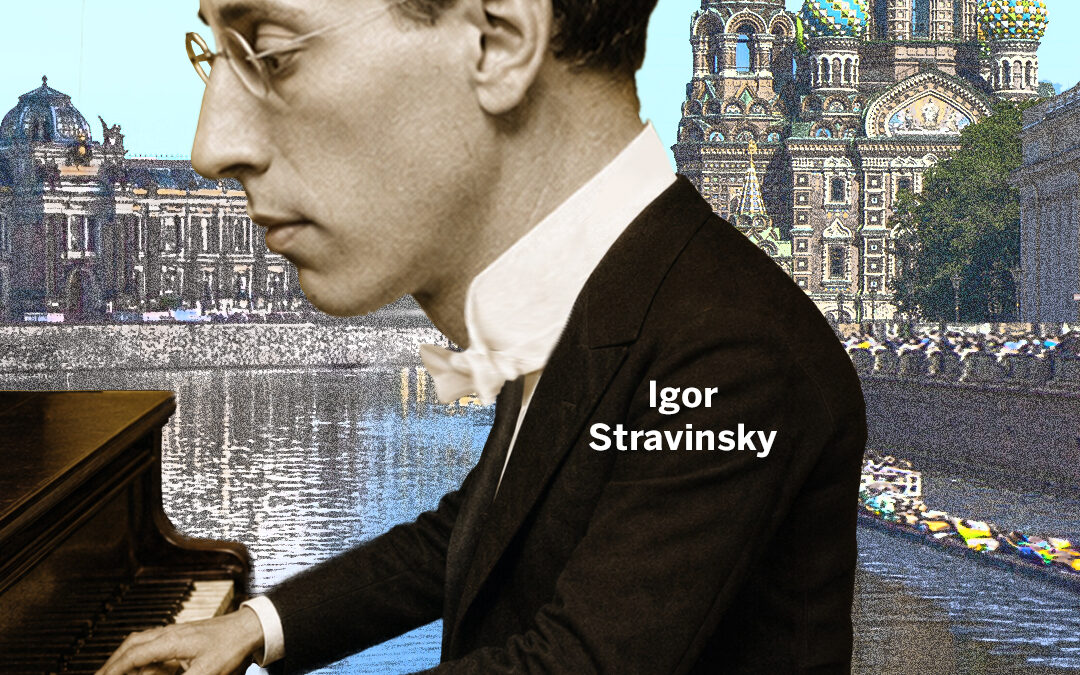
In 1910, the Russian impresario Serge Diaghilev and his choreographer Michel Fokine took a chance on 27-year-old Igor Stravinsky to compose music for their dazzling ballet, The Firebird. The story (a conglomeration of several Russian folktales) tells of the downfall of evil Kastchei the Deathless, who seizes young princesses as captives while turning the knights who arrive to rescue them into stone. The hero Crown Prince Ivan recruits the Firebird, named for her beautiful feathers that flicker like flames, to help destroy Kastchei and free his victims.
The Firebird is pure sonic magic. The suite opens with a low, mysterious Introduction that creeps into the dazzling, fluttering woodwinds of the Dance of the Firebird. A tender, lyrical oboe melody centers the Round Dance of the Princesses, lulling the audience into safety before the orchestra erupts into the mayhem of the Infernal Dance of King Kashchei, complete with barbaric snorts and growls from the brass. In true fairy-tale fashion, order is restored through a hypnotic bassoon solo in the Berceuse (Lullaby), which leads directly into the Finale — a triumphant, brass-led celebration built on a traditional Russian folk song (in mixed-meter!) Perceptive audiences might hear that Stravinsky uses typical harmonies for music of the mere mortals, while the supernatural creatures use extended orchestral techniques, octatonic scales, and complex rhythms.
The lavish Firebird premiere was a huge success in every respect. The dancers, costumes, choreography, stage sets, and music dazzled Parisian audiences and critics alike. The 1919 Suite is a reduction of the 45-minute ballet both in length and instrumentation, tightening up the story into six movements, and is the most popular version performed today.
The Firebird is the birth of musical modernism. Without it, there would be neither Petrushka nor The Rite of Spring. Stravinsky remains deeply rooted in traditions of his teacher, Rimsky-Korsakov (the orchestral richness, the parallel octaves, the chromatic sensuality), but he is already breaking new ground. The “Infernal Dance” anticipates the primal rhythms of “The Rite of Spring,” while the static harmonies of the “Round Dance” hint at the neoclassicism of his later years. It’s a brilliant evolutionary leap: the last great “Russian” ballet and, at the same time, the first “modern” one.
Firebird Suite
Composed in 1919
By Igor Stravinsky