20th Century, Concerto, Works
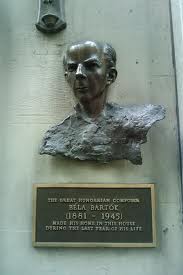
 If you walk along 57th Street near Broadway, you can still see it. On the side of an ordinary-looking building, a small bronze plaque: “The great Hungarian composer Béla Bartók (1881-1945) made his home in this house during the last year of his life.”
Each time I pass this spot, I think of the man who, dying of leukemia in a tiny apartment, far from his beloved Hungary, composed this surprisingly positive concerto during the summer of 1945. He wrote it as a birthday gift for his wife, the pianist Ditta Pásztory Bartók. It is likely that he hoped it would provide her with some income after his death. Bartók completed all but the last seventeen bars himself; these last measures were orchestrated by his composer-friend Tibor Serly, based on Bartók’s sketches.
It is easy to hear the second movement (Adagio religioso) as a response to Bartók’s own illness. True or not, there is one other quite definite reference: to Beethoven’s string quartet in A-minor, op. 132, which he composed after a serious illness.
Profoundly beautiful as the concerto’s second movement is, the gracefulness of the first and the impetuous energy of the third are equally compelling. This is about as far from death-haunted music as one can get. I hear it in my mind everytime I’m on 57th Street, and I’m always astonished.
20th Century, Concerto, Works
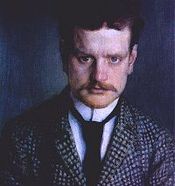
Born in 1865, Jean Sibelius grew to be considered a national hero in his native Finland. A Romantic Nationalist, Sibelius even had his picture on the $100 Mark for a time.
Sibelius’s rise to fame came as Finland was fighting for independence against Lenin and the Soviet Union. “Finlandia,” one of Sibelius’s most famous works, was written during this period and at one point was considered the Finnish national anthem.
As a boy, Sibelius had dreams of becoming a famous virtuoso violinist. However, he started his training as a lawyer at the University of Helsinki. His love for music eventually got the best of him, and he transferred to what is now the Sibelius Academy of Music, which at the time was called the Helsinki School of Music.
Widely known as a symphonist, Sibelius wrote seven symphonies and had agreed to write an eighth, which was scheduled for a premiere but never came to fruition.
Sibelius’s Violin Concerto (the only concerto he wrote) is symphonic in scope and is marked by melancholy melodies and dark harmonies. Sibelius uses the violin as part of the texture while displaying the instrument’s virtuosic qualities and giving the orchestra equal importance.
Though Sibelius was himself a violinist, he composed only one violin concerto. This music did not come easily, perhaps because he was so close to the instrument.
The violin concerto was premiered in Helsinki in February 8th, 1904 and was considered a disaster. This was partially Sibelius’ fault as he didn’t finish the piece until the last minute and therefore didn’t give the soloist enough time to learn it.
After the first performance, Sibelius revised the work extensively to the version we know today. It was given a second “premeire” in Berlin, conducted by Richard Strauss, and was received very well. After this performance it was played a few more times, but slipped into obscurity until 1991 when the Sibelius estate allowed one performance and one recording to be published. Since that time it has become a mainstay in the violin repertoire.
By 1903, Sibelius had already composed his first two symphonies and a series of overtly nationalistic works: the Karelia Suite; the choral “Kullervo” symphony; the four Lemminkäinen legends; and the famous tone-poem Finlandia. All of these bore the hallmarks of late Romanticism; but his style was about to undergo a marked change.
By the time of the Third Symphony (1907), his music had become harder-edged, condensed, and rigorously organized. The Violin Concerto thus stands at a turning point in Sibelius’s output. Janus-like, it looks two ways at once: back towards the expressive romanticism of his earlier years, and forwards toward the concise, rugged, highly concentrated music of his future. Both of these elements can be heard in this work, which remains one of the pinnacles of the violin concerto repertoire.
Concerto, Romantic, Works
This concerto was Brahms’ first attempt at symphonic writing. He sketched the majority of the work in 1856. For a while it took the form of a two-piano sonata; then he orchestrated it, striving for a symphony. Finally, it was completed as a piano concerto, but one very different in nature from the piano concertos of its era.
Material from the symphony’s first and second movements was retained for the concerto; the last movement was replaced with an upbeat Rondo in Hungarian style. From the dramatic opening of the forceful theme to the rousing finale, the piano weaves in and out of the texture and becomes an integral part of the whole piece. In the slow Adagio, Brahms pays tribute to both Clara and Robert Schumann. In 1856, he wrote to Clara, “I am painting a lovely portrait of you. It is to be the Adagio.” The inscription on the original manuscript of this hymn-like movement is: “Benedictus qui venit in nominee Domini.” Aside from its religious connotations, it suggests a dedication to Robert Schumann, who had recently died, and whom Brahms referred to as “master” or Dominus.”
Classical, Concerto, Works
Mozart’s twenty-seven piano concerti represent the absolute apotheosis of the form: in the same way that Haydn perfected the string quartet, Mozart took the piano concerto and brought it to its peak.
His later works in this genre, written in Vienna under increasingly difficult conditions of financial worry and illness, seem to reach for ever greater heights of expression and classical grace. They are at once brilliant and impressive, yet never border on being shallow or superficial; indeed, they explore the entire range of human emotion. The balance between orchestra and soloist is nothing short of miraculous, and the intensity of expression that is achieved with astonishingly simple means is unsurpassed in the literature. In a way, perhaps these concerti can be called the most ‘Mozartian’ music of all.
The C minor concerto has justly become a perennial favorite. One of Mozart’s most personal creations, it is forceful and tragic, full of shadows and darkness. He completed the work in March 1786, premièring it in April, when he conducted from the keyboard. Perhaps most remarkable is the richness and complexity of the woodwind writing throughout, interacting with the soloist in a perfect partnership usually only found in chamber music.
The first movement, uncluttered and completely lacking in embroidery, never once sacrifices musical expression for sheer virtuosity. After such drama, no one else could have written such a transcendently beautiful larghetto, cast here in crystalline rondo form of almost divine simplicity. The work finishes with a set of variations, rushing to a dramatic close with a crushingly tragic coda in 6/8 time.
Baroque, Concerto, Works
Handel was a keyboard virtuoso as well as a great composer. He wrote 15 organ concerti between 1735 and 1751, and has been credited as being the first to compose an organ concerto. In addition to utilizing the “king of instruments” as a solo voice, Handel left plenty of room in these works for his own improvisation and solo flourishes.
The B-flat concerto opens with a magnificent chaconne in linked sections, with a noble theme and variations played over a relatively simple harmonic structure. In addition to its grandeur, it is noteworthy as the only instance in Handel’s organ concertos where the use of the pedal is specified. A reflective slow movement follows, leading to a sprightly fugal allegro which Handel borrowed from one of his string concertos. The fourth movement is for solo organ, one of many instances in these concertos where Handel allowed for the organist to freely improvise or play an appropriate short work (here in the contrasting key of G minor). The concerto ends with the bourrée, a lively stylized dance movement.
Concerto, Romantic, Works
Sir Edward Elgar (1857-1934) was a dominant force in English music at the turn of the 20th century. His magnificent ‘cello concerto was composed in 1919; more recently, it has become identified with the great ‘cellist Jacqueline du Pré, who made it into her signature piece (and is used in the movie Hillary and Jackie.)
This 4-movement work displays an astonishing sweep of emotion and melody, from tragedy and pathos to exuberance. After a declamatory ‘cello opening, the first movement settles into an introspective lilt, punctuated by solo flourishes and dramatic orchestral statements. It is followed without a break by the witty second movement, with its brilliant solo passagework and lightly-textured accompaniment.
A romantic adagio allows the ‘cello to display its singing qualities to the fullest. The dramatic last movement is at times almost operatic, with the ‘cello and orchestra playing off each other’s themes; towards the end, themes from the adagio and opening movements make an encore appearance before a dash to the dramatic finish.
20th Century, Concerto, Works
No notes available.
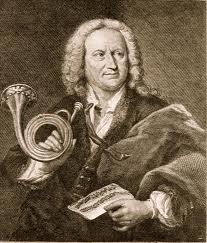
Baroque, Concerto, Works
Many of Bach’s cantatas and oratorios include instrumental sections, such as sinfonias or overtures, which are musical masterpieces in their own right. Bach freely interchanged his compositions as he saw fit, borrowing from his instrumental works as needed to fill out his vocal works, and vice versa.
This Concerto in D major is based on the first three movements of the Easter Oratorio, which according to musicological research may well have been performed separately as a three-movement instrumental concerto.
The first two movements (Allegro and Adagio) are taken verbatim from the Oratorio. The third movement is based on the Oratorio’s following choral number, with the original orchestral opening and accompaniment, and vocal lines arranged for instruments. The first and third movements of this concerto are scored for a large orchestra of trumpets, timpani, oboes, bassoon, strings and continuo. Majestic openings contrast with more quiet, introspective sections, including a section featuring solo violin in the first movement and a section with a small violin-oboe-continuo chamber ensemble in the third movement.
The second-movement Adagio is a mellifluous oboe solo over string accompaniment, serving as an introspective contrast to the exuberant outer movements.
Concerto, Romantic, Works
This concerto is certainly one of the most familiar, and best-loved, works in the entire violin repertoire. It was composed in 1844 expressly for the violin virtuoso Ferdinand David and performed in Leipzig the following year.
Its three movements are essentially meant to be played without pause (although there is a slight break between the second and third movements). After a one-measure introduction, the famous opening theme is introduced by the solo violin, and gradually picked up by the entire orchestra. A lyrical theme is introduced by the winds midway through the movement; the cadenza makes an early appearance, leading to the recapitulation of the opening theme.
The second movement is essentially a “song without words,” simple and hauntingly beautiful. After a restless introduction, the solo violin introduces the last movement’s theme – an elf-like motif, evocative of Mendelssohn’s incidental music to A Midsummer Night’s Dream. A second robust orchestral motif makes its appearance; Mendelssohn thoroughly mixes the two themes in the contrapuntal section that follows. A triumphant coda brings the concerto to a close.
Concerto, Romantic, Works
Vivaldi, himself a violinist, wrote over 500 concertos, and interestingly enough, besides the 230 for violin, wrote more concertos for the bassoon than for any other instrument. Even though, like Bach, Vivaldi was forgotten for decades, the resurgence in scholarship of baroque music in the late 19th century brought him back into recognition.
In his own time, Vivaldi was actually quite influential, having established some standard-practice techniques of baroque composition and serving as a model for the young Bach. Even though he borrowed his own material liberally, as was the practice at the time, he was nonetheless very inventive, especially in string writing. He devised different expressive techniques in string articulation and bowing.
One can hear this transparently in the bassoon concerto we are performing, a graceful string texture backing up the remarkable solo bassoon fireworks and melodic display.