Strauss composed his elegant oboe concerto in exile in Switzerland shortly after the end of World War II.
A far cry from Strauss’ lush late romantic tone poems, the concerto harks back to the classicism of Mozart. Its themes are harmonically lucid and charming. The work is sparely scored for soloist and chamber orchestra (strings, woodwinds and horns).
The first movement is based on a recurring four-note motif in the strings, followed immediately by the soaring oboe melody and extensive thematic and harmonic development. The second movement, which follows without a break, includes an extended oboe cadenza accompanied in part by the orchestra. The sprightly third movement starts off with intertwined melodies involving the solo oboe, flute and clarinet. After a short cadenza, the main theme is transformed into a sweeping 6/8 closing Allegro.
Many of the motifs played by soloist and orchestra involve leaps and jumps reminiscent of other famous Strauss tone poems.
The life of William Boyce (1711-1779) spanned the flowering of the baroque era through early classicism. Boyce was active in official London music circles, becoming Composer to the Chapel Royal in 1736 and Master of the King’s Musick in 1755.
He composed a number of symphonies, concerti grossi and overtures for various combinations of strings and winds (although his best-known work is the song “Heart of Oak” which he wrote for a theatrical pantomime).
He published his twelve overtures in 1770, still mostly in high baroque style. They are based largely on celebratory Odes for royal birthdays which Boyce was required to write as part of his official duties.
Overture No. 11 is based on the 1766 Birthday Ode and features strings, oboes, bassoon, trumpets and timpani. The trumpets and timpani play a prominent role, particularly in the formal introduction and the fugue which follows.
The Russian contemporary of Honegger, Sergei Prokofiev grew up in the atmosphere of late Russian Romanticism that he abandoned as soon as his compositional style gained strength and individuality. His works already had very early on a motor, sometimes anti-emotional character, a tendency that Prokofiev, in the 1930s, would call “New Simplicity”—a rather theatrical, staged return to classic forms and means of expression different from Romanticized music.
After the Soviet revolution, Prokofiev in 1918 was granted an exit visa from the new Soviet government and went to Paris, where his 1st Violin Concerto received its premier. Although it had been difficult to find a soloist for the first concerto—many violinists “flatly refused to learn that music”—the 2nd Violin Concerto was commissioned by a group of admirers of the French violinist Robert Soëtans.
Written in 1935, shortly before his final return to his home country Russia (which he visited only briefly, having worked abroad since 1918), Prokofiev wrote: “The variety of places in which the concerto was written is a reflection of the nomadic concert-tour existence I led at that time: the principal theme of the first movement in Paris, the first theme of the second movement in Voronezh, the instrumentation was completed in Baku and the first performance was given in Madrid.”
Pastorale d’Eté (Summer Pastoral), written in 1920 during a vacation in the Swiss Alps and subtitled “Poème Symphonique,” was inspired by a quotation from Arthur Rimbaud: J’ai embrassé l’aube d’été (“I’ve embraced the dawn of the summer”).
Honegger expresses his impression of this summery idyll in Switzerland with pastoral and shepherd airs that often recall Beethoven’s “Pastoral Symphony”. The happiness is never disturbed. The three parts – calm, lively and gay, calm – merge into one another, the third combining and superimposing the musical elements of the first two.
This is one of the best-known and most programmatic symphonies in classical music.
Composed in 1808, it reflects Beethoven’s deep feeling for nature, no doubt due in some measure to his numerous walks in the countryside around Vienna. Each of the five movements is subtitled and reflects a particular mood.
The first movement allegro (“awakening of joyful feelings on arriving in the country”) is announced by the violins, and in turn taken up by winds and the full orchestra. “Scene at the brook” features a rustling accompaniment of second violins, violas and solo ‘cellos set against melodic motifs in the first violins and winds. Rustic dances are featured in the “happy gathering of the country folk” which follows.
The dramatic “thunder, storm” movement, with sudden bursts by timpani and brass, suddenly interrupts the country revels. Then the storm departs, the sun breaks through, and the “shepherd’s song,” with “happy and thankful feelings after the storm,” takes us to the end of this musical journey.
Barber set this masterpiece to a poem by American author James Agee (1909-1955). Knoxville was first performed in 1948 by soprano Eleanor Steber with the Boston Symphony Orchestra under the direction of Serge Koussevitsky.
It evokes a summer evening in the backyard of a southern town, as seen through the eyes of a small child. It starts out calmly. The main motive of several falling and rising notes appears in the solo winds (oboe, clarinet and bassoon) in the first few measures. This transitions to a wistful, poignant depiction of the scene – people rocking on porches, talking about everyday things, looking at people and buggies going by in the street.
The agitated middle section starts abruptly – a vivid depiction of “a streetcar raising its iron moan; stopping; belling and starting, stertorous …” After the streetcar fades into the distance, the scene and music revert to the backyard scene – calm again at first, then more urgent as the child’s thoughts turn to the family, life and living, and her place in the world.
Many of Vaughan Williams’ compositions incorporate elements of folk music. This short suite was originally composed for a military band and is entirely based on English folk tunes – “Seventeen Come Sunday,” “My Bonny Boy,” and a set of folk songs from Somerset.
The suite was arranged for full orchestra by Gordon Jacobs, one of Vaughan Williams’ students and a composer in his own right. The orchestral arrangement received Vaughan Williams’ endorsement after its publication in 1924.
The two outer fast movements are sprightly, in march tempo. They evoke the British Empire at its martial zenith, with emphasis on brass and percussion. The middle movement is wistful and contemplative, with plaintive wind solos alternating with the strings.
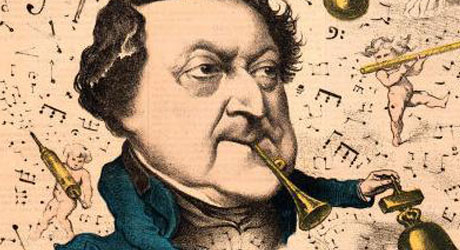
Gioacchino Rossini (1792-1868) is best known for his masterful comic operas. He was a prolific composer who, at one point, composed 16 operas in 6 years – and then retired when he was 37 years old!
Rossini wrote this overture for one of his best-known operas, The Barber of Seville, which premiered in Rome in 1816. Opening with a loud fanfare, it immediately drops to a whisper – foreshadowing the comic (yet elegant) nature of the piece. Abruptly shifting gears to a fast tempo in a minor key, Rossini alternates thunderous fortissimos with witty wind melodies. Several long crescendo passages add even more drama to the overture, which finishes with a flourish at the end of a breakneck finale.
When Charles II mounted the throne in 1660, one of his first acts was to lift the ban on theatrical performances, imposed by the Puritans during the Commonwealth years after the Civil War of 1642. Very soon, the ‘masque’ entertainment, involving music, spectacle, dance and drama, was again a thriving business.
Indeed, Purcell himself wrote incidental music (‘incidental’ as it was not part of the action, but occurred in the intermissions and interludes) for 43 plays in all. Several of these were preserved in the Orpheus Britannicus collection, thanks to which we still have many of these wonderful pieces today.
Although the original play of 1690 is now lost, these lovely dance movements remain, here orchestrated by another great English composer, Gustav Holst. They all display Purcell’s delight in harmonic pungency, wonderfully independent contrapuntal writing and endless inventiveness (the Jig is actually an ingenious arrangement of the popular tune Lilliburlero, with the melody in the bass).