
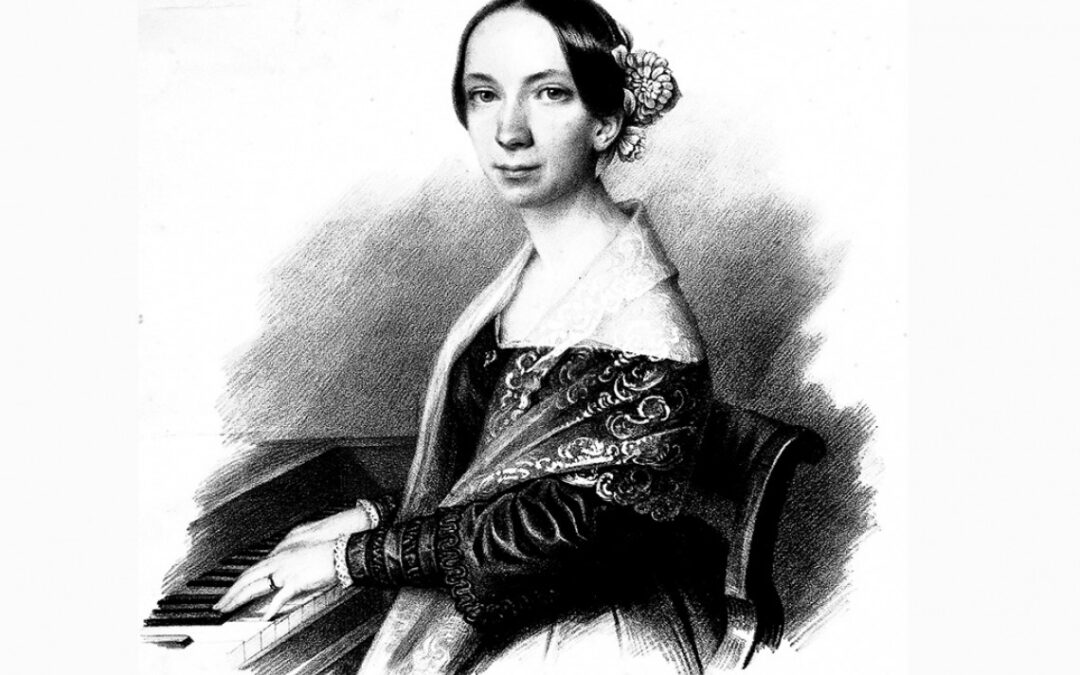
Emilie Mayer (1812 – 1883) is often called the “female Beethoven.” Her music was highly regarded in her own time, and is marked by inventive harmonies within the traditional Germanic forms. Over her career, Mayer composed eight symphonies, seven symphonic overtures, eight violin sonatas, twelve cello sonatas, seven string quartets, and six piano trios.
Mayer was born to a wealthy pharmacist in Friedland, Germany in May of 1812. Unlike many of her contemporaries, Mayer was encouraged to pursue music and composition by her family and male mentors, and not expected to solely be a wife and mother. Important regional composer Carl Loewe, said of Mayer that, “such a God-given talent as hers had not been bestowed upon any other person he knew,” and championed her work amongst his colleagues.
After relocating to Berlin in the 1850’s, Mayer became connected with influential musicians and patrons in the city’s concert scene. She traveled to Cologne, Munich, Leipzig, Halle, Brussels, Strasbourg, Dessau, and Lyon to oversee various performances.
The Overture D minor was written in 1850-55, after the premiere of her First and Second symphonies. It skews solidly romantic, beginning with a mysterious introduction in the lower strings. The following allegro section is marked by rhythmic sharpness, echo effects in the winds, and development of lyrical themes. Mayer’s compositional hallmarks of expressive harmonic shifts lead to surprises around every corner.
Overture No. 1 in D Minor
Composed in 1850-55
By Emilie Mayer