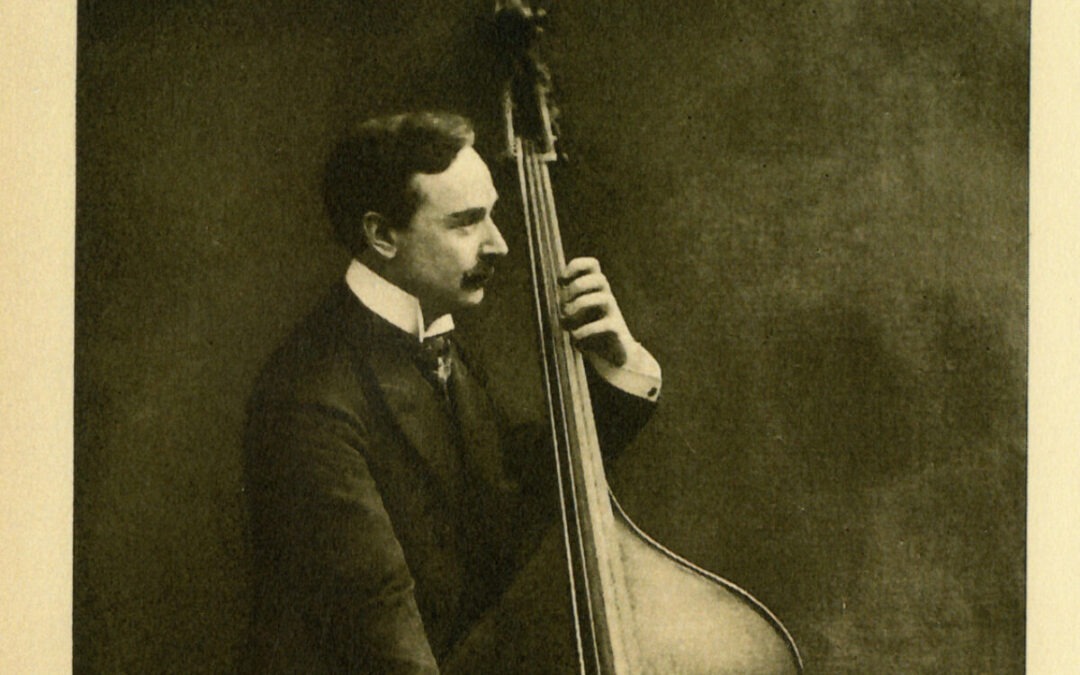
Before becoming music director of the Boston Symphony Orchestra in 1924, Serge Koussevitzky was a celebrated Russian double-bass virtuoso and champion of the instrument. He composed his bass concerto between 1902 and 1905, and it was premiered in 1905 with the Moscow Philharmonic (with Koussevitzky himself as the soloist. It has since become one of the best-known works in the double bass repertoire.
The concerto is in three movements, and written in lush late-romantic style reminiscent of Tchaikovsky, Dvoràk and Rachmaninoff. It showcases both the lyrical and virtuosic aspects of the solo double-bass, in contrast to its typical orchestral role.
The first movement Allegro opens with a stirring 6-note introduction in the French horns, taken up by the orchestra. Two short bass cadenzas in recitative style lead to the first theme, an expressive melody that showcases the instrument’s upper register. The contrasting sections that follow features technical passages and a second lyrical theme, and another virtuosic technical display.
The first movement leads without a break into the soulful Andante, with a reduced orchestral texture and the addition of a harp. The cantabile theme showcases the upper double-bass register, and is echoed by the orchestra. An ethereal ending, featuring the soloist, winds and harp, brings the Andante to a close.
The vigorous third movement Allegro reprises the opening movement, with bravura technical passages leading to an impassioned ending.
Double Bass Concerto
In F# Minor, Op. 3
Composed in 1902
By Serge Koussevitzky