20th Century, Occasional Piece, Works
Sir Peter Maxwell Davies (called “Max” by many of his friends) has long been one of Britain’s most respected composers. He was born in Manchester, England, and studied music at the University of Manchester and the Royal School of Music. After further study in the United States and Australia he returned to England where he created a virtuoso chamber group called The Fires of London to perform works by himself and his colleagues. For a time they were the rage in avant garde musical circles.
But Maxwell Davies was drawn increasingly to write music that was not only modern but that was communicative and accessible. You will see this reflected in his composition An Orkney Wedding, with Sunrise.
Composer’s Note:
“An Orkney Wedding was written for the Boston Pops Orchestra as a commission for its centenary, and conducted at the first performance by John Williams. It is a picture postcard record of an actual wedding I attended on Hoy in Orkney.
At the outset, we hear the guests arriving, out of extremely bad weather, at the hall. This is followed by the processional, where the guests are solemnly received by the bride and bridegroom, and presented with their first glass of whisky. The band tunes up, and we get on with the dancing proper. This becomes ever wilder, as all concerned feel the results of the whisky, until the lead fiddle can hardly hold the band together any more.
We leave the hall into the cold night with echoes of the processional music in our ears, and as we walk home across the island, the sun rises, over Caithness, to a glorious down. The sun is represented by the highland bagpipes, in full traditional splendor.”
20th Century, Symphony, Works
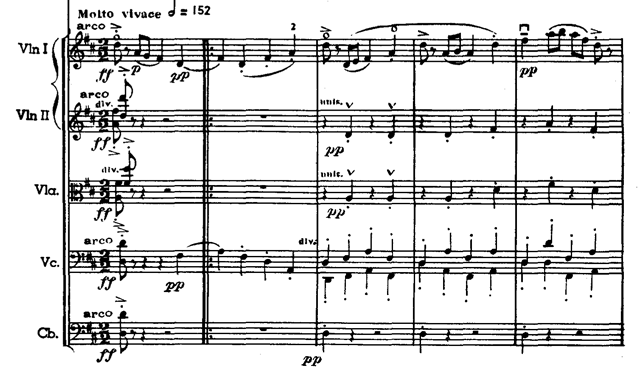
By the time Prokofiev wrote his first symphony, he was already well-known as a child prodigy and the enfant terrible of twentieth century Russian composition. His pugnacious rhythms, violent melodic gymnastics and experiments with multi-tonality had already become recognizable trademarks (Stravinsky once said his music had ‘personality’, whatever its supposed aesthetic failings), and audiences had come to expect these elements of conflict in his music.
However, staying in 1917 in the Russian countryside (he was exempt from military service as the only son of a widow), he became interested in writing a work completely away from the piano. As a renowned virtuoso, the piano was his usual compositional tool, but by working without its aid, he hoped that the orchestra would sound more natural. The result was his first symphony: his one foray into Neo-classicism, it harks back to the symphonies of Haydn and Mozart in its reduced instrumentation and formal plan, although maintaining the biting wit (or is it sarcasm?) that is so much a part of his natural expression.
The work opens with a light, airy, exhilarating first movement, with gravity-defying leaps in the second subject. Later he expands on this high string register when the theme of the second movements floats in on stratospheric violins. Prokofiev replaces the typical third movement minuet of Haydn and Mozart with an even older dance, the gavotte, classically partnered with a droning musette; he was later to incorporate this movement into his Romeo and Juliet suite. The joyous finale is full of inventive counterpoint and bursting with irrepressible energy.
20th Century, Suite, Works
Fauré was commissioned to write the music for this suite by Prince Albert I of Monaco in 1919 as accompaniment to a choreographic divertissement. This “staged entertainment” was inspired by a Paul Verlaine poem and premiered in Monte Carlo.
In 1920, Fauré arranged the music as a four-movement suite. It consists of a Mozartian overture; a menuet and gavotte in faintly baroque style, and a final pastorale.
Of interest from a composition point of view is that the first three movements were, essentially, orchestrations of earlier works that Fauré had composed for piano some 50 years earlier. The dreamlike, wistful pastorale was composed in 1919, just 5 years before his death.
20th Century, Concerto, Works
No notes available.
20th Century, Symphony, Works
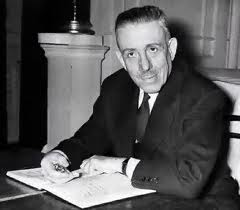
French composer Francis Poulenc (1899-1963) almost defies characterization in terms of musical style. He was a member of the famed composer group known as “Les Six” and played a prominent role in 20th-century music.
He wrote many well-known works for the stage (Les Mamelles de Tiresias, Les Biches, Dialogues of the Carmelites), as well as numerous chamber works and concertos.
His Sinfonietta is one of his few large-scale orchestral works. It was commissioned in 1947 for the BBC, and premiered the following year. While Poulenc originally conceived of it as a short, 15-minute work (hence the title), it blossomed into a more substantial four-movement symphony, full of vigor, beauty and wit, with equal prominence given throughout to strings, woodwinds and brass.
The first movement begins with a serious and dramatic minor-key opening, with subsequent rising motifs passed around the orchestra. There is an unusual slow interlude in the middle of the movement in which solo winds are prominently featured, and a calming major-key ending.
The second movement is a lighthearted scherzo, with three witty themes introduced by the strings. The Andante cntabile features winds and strings in melodies written by Poulenc in late-Romantic, almost Brahmsian, style. The Finale is a romp, with an abrupt introduction, several incisive and witty themes, and a surprise ending.
20th Century, Solo with Orchestra, Works
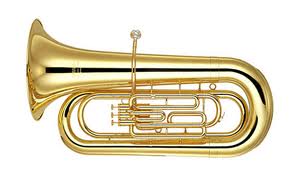
“Tubby,” with music by George Kleinsinger and story by Paul Tripp, was composed in 1946. It serves as a wonderful introduction to the orchestra, and has become a well-loved children’s classic.
It tells the story of Tubby, a fat little tuba who just wants to be treated like all of the other instruments of the orchestra. As the lowest-sounding instrument, Tubby usually just gets to play “oompah-oompah.” What he really wants is to play pretty melodies just like all of the other instruments in the orchestra!
When Tubby first tries to do that, the other instruments make fun of him. After rehearsal, Tubby goes home and sits sadly by a riverbank; but there, he meets a big bullfrog, who teaches him a wonderful new melody. At the next rehearsal, the conductor gives Tubby the chance to play his new melody. Tubby plays it so beautifully that all the other instruments love it and want to play it too!
Everyone joins together in the rousing finale, making Tubby a very happy tuba indeed.
20th Century, Occasional Piece, Works
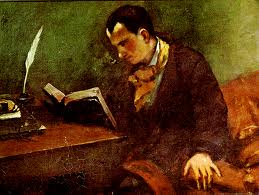
Voyage is a string-orchestral version of the choral setting of Richard Wilbur’s translation of Baudelaire’s “L’Invitation au Voyage.” The lyrical, seamless vocal lines translated themselves naturally to strings, and the burnished imagery of the poetry finds a happy companion in the richness of the instrumental choir.
20th Century, Works
Perhaps the most famous children’s work ever written, Peter and The Wolf was composed by Sergei Prokofiev in 1936 as a way of introducing children to the instruments of the orchestra.
It opens with Peter, a brave little boy (played by the strings), going out into the meadow and observing a bird (the flute) and a duck (the oboe). The bird and the duck begin talking and then quarreling. A cat (the clarinet) comes along and tries to catch the bird, which flies away. Grandfather (the bassoon) appears and is angry that Peter is in the meadow. It’s dangerous out there; if a wolf should come along, what would Peter do then? Although Peter says he is not afraid, Grandfather takes Peter back home and locks the gate. Sure enough, an enormous wolf (three French horns) suddenly appears; the wolf then chases, catches and swallows the duck.
But Peter, with the help of the bird, manages to trap the wolf with a lasso. The hunters, who had been tracking the wolf, appear and help Peter take the trapped wolf to the zoo. Peter, the hunters, the wolf, grandfather, the cat and the bird then join in the triumphal procession. Even the duck’s quacking is heard, because the wolf had been in such a hurry that he had swallowed the duck alive!
20th Century, Concerto, Works
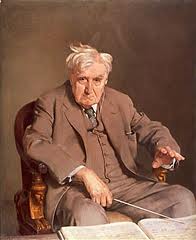
Written in 1954, this short 3-movement work was Vaughan Williams’ last concerto.
It is a compact work, with 2 modernistic outside movements surrounding a slow movement. It begins with a vigorous opening built around rising and falling scale-like passages. This is followed by a second theme (a little reminiscent of Hindemith in style), and a third, folk song-like theme.
The second movement harks back to Vaughan Williams’ earlier melodious and dreamy style. Orchestra and soloist both take part, weaving in and out of the musical fabric; the tuba’s sonorous capabilities are on full display in the scale-based theme followed by baroque-like ornamentation.
The concluding Finale is a rollicking “German rondo” (“Rondo alla Tedesca”), with a robust main theme first played by the tuba and echoed by the orchestra; the second theme is harmonically more adventurous, with a plaintive, almost urgent feel to it. After successive, ever more frenetic renditions of the 2 themes, the concerto ends in a furious dash.
The first and third movements both contain substantial solo cadenzas displaying the tuba’s range and versatility.
20th Century, Solo Vocal, Works
This extraordinary work was composed for tenor Peter Pears and horn player Dennis Brain in 1943. It consists of six songs set to English poems framed by a solo horn prologue and epilogue. While many of the poems deal in some fashion with sleep, decay, or death, each has its own distinct character, beautifully set off by the interplay between the two soloists and the strings.
The Pastoral (“The Day’s grown old”) by Cotton describes a late afternoon scene in the countryside with flocks of sheep, lengthening shadows and sunset. “The splendour falls on castle walls” (“Blow Bugle Blow”) by Tennyson evokes the heroics of a bygone age, with bugle calls echoing and dying in a craggy landscape.
For Blake’s doleful Elegy (on its face, about a rose and its destruction by the worm that finds it), Britten has composed horn and tenor melodies based on minor second motifs. It leads directly into the Dirge, a haunting 15th-century anonymous poem about death and whether salvation or damnation awaits the deceased, depending on his/her conduct in life. The Dirge is also notable for its structure, a multi-voiced fugue played by the strings and horn over an ostinato sung by the tenor.
Ben Jonson’s hymn to Diana the huntress is set as a spritely hunting tune, while Keats’ Sonnet (“O soft embalmer of the night”) is a paean to sleep.