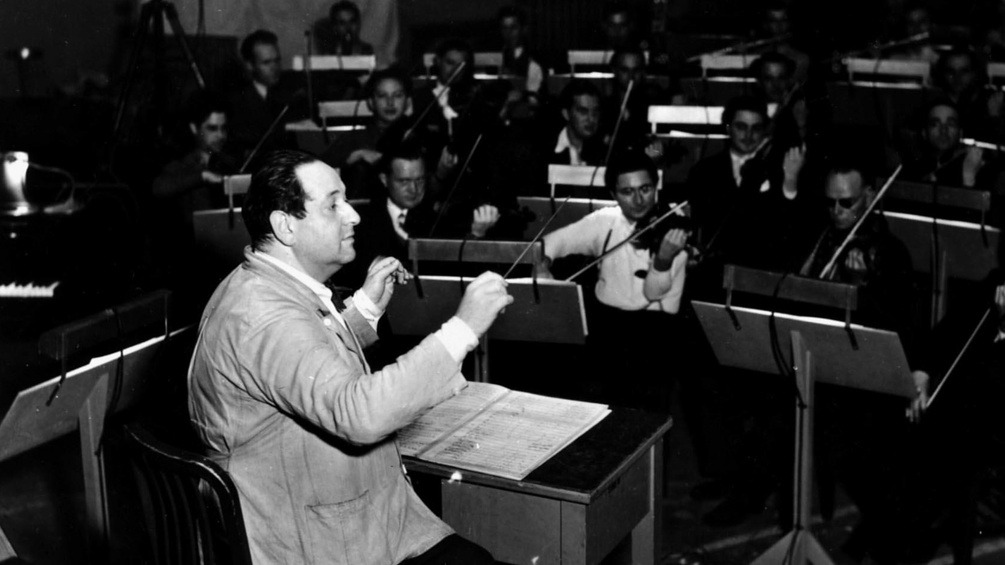
Erich Wolfgang Korngold was the son of Julius Korngold, the most influential music critic in early 20th-century Vienna. His parents, who came from a bourgeois Jewish background, gave their son his middle name in honor of Wolfgang Amadeus Mozart. He grew up in turn-of-the-century Vienna, a world capital of music – the city of Brahms, Strauss and Mahler. Korngold was regarded as one of the most avant-garde Viennese composers of his day. A musical prodigy, he started composing at the age of six. When he was 10, his father took him to meet the great Gustav Mahler, who pronounced him “a genius.” His works, including piano pieces, a piano trio, and a ballet-pantomime, started being published in his early teens. Numerous other compositions followed, including operas (such as “Die tote Stadt”), piano sonatas, chamber music, songs, and other stage works.
He thrived up until the mid-1930s, when the threat of Hitler and Nazi Germany started to loom large. In 1934, Korngold was asked by Max Reinhardt, a prominent director with whom Korngold had collaborated in Europe, to travel to Hollywood to work on scoring music for motion pictures. His first film score in 1934 was for a film version of Shakespeare’s “Midsummer Night’s Dream,” and was a success. Despite that, Korngold was not comfortable in Hollywood and went back to Vienna in 1937. As the Nazi threat to Austria loomed, Korngold fortunately was offered another Hollywood contract to score films and took it, leaving Vienna in early 1938 right before the Nazi takeover of Austria.
Once in Hollywood Korngold became the most celebrated film composer of cinema’s “golden age.” Drawing on his musical background in concert music, opera and operetta, he wrote scores for such celebrated films as “The Adventures of Robin Hood,” “Captain Blood,” Elizabeth and Essex,” “The Sea Hawk,” “Green Pastures,” and many others, winning two Oscars for film scoring. Through his film scores, Korngold created the “Hollywood style” of film music, which still influences film composers up to the present day.
During World War II, Korngold focused exclusively on his film scores. After 1945, he began once again to compose classical pieces – among them two concertos, a symphony and a string quartet. His violin concerto – with its soaring lyricism, virtuosic demands, and cinematic drama – quickly became a favorite of the solo violin repertoire. It was premiered by Jascha Heifetz in 1947 and was an artistic triumph, quickly becoming a staple of the violin concerto literature. Its style is hyper late-romantic, with Korngold’s lush tonal colors and typical instrumentation featuring vibraphone, harp, celesta, glockenspiel and bells.
The concerto is in three movements, each of which is based on themes taken from his 1930s film scores. The Moderato nobile is in a traditional format (exposition, second theme, development, recapitulation, and coda). Its opening soaring theme (in fourths and fifths) is taken from his film “Another Dawn.” Its second lyrical theme comes from “Juarez.” The meditative Romance is a prolonged meditation on a love theme (”Anthony Adverse”), and features a “mysterioso” section in the middle which pushes harmonic boundaries. The Finale is based on themes from “The Prince and the Pauper,” featuring a rollicking initial motif introduced by the soloist, and a dramatic second-theme climax leading to a triumphant ending.
Violin Concerto
In D Major, Op. 35
Composed in 1945
By Erich Wolfgang Korngold